
Company
September 22, 2026
Who is Rachel St. Clair?
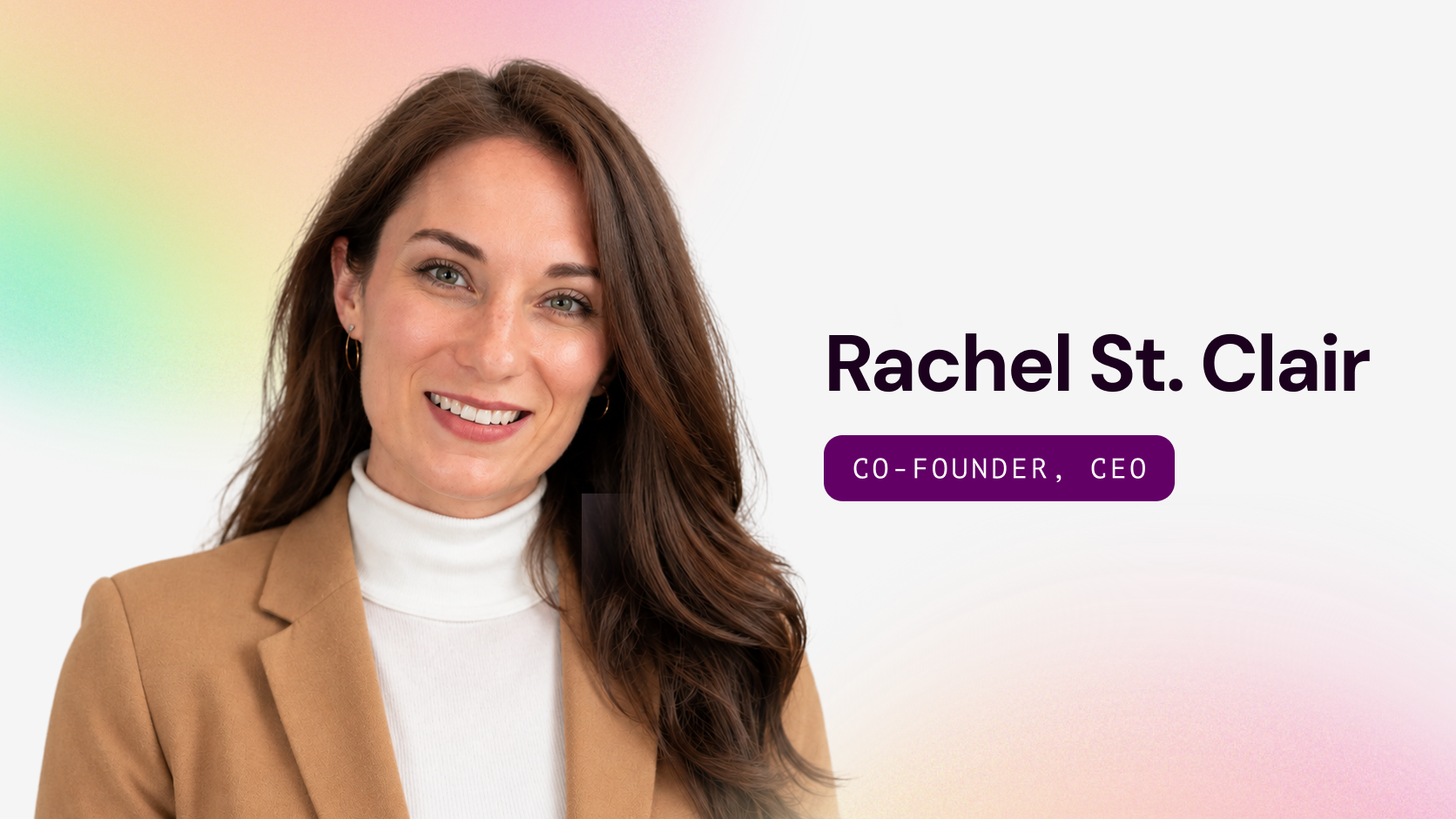
Rachel St. Clair is the Co-Founder and CEO of Servamind, a research company with one mission — more mind per machine. Servamind builds a new layer underneath the model. She holds a PhD in Complex Systems and Brain Sciences. Her research spans catastrophic forgetting, network modularity, and machine consciousness.
Key takeaways
- Rachel St. Clair is Co-Founder and CEO of Servamind, where the mission is more mind per machine.
- Servamind's data layer, the Serva Encoder, makes fine-tuning faster and inference cheaper on the stack a team already runs.
- Her research covers catastrophic forgetting, network modularity, and machine consciousness.
- She has published peer-reviewed work with L. Andrew Coward and Susan Schneider.
- Rachel St. Clair keynoted AGI-24, the longest-running research conference on artificial general intelligence.
What does Rachel St. Clair do at Servamind?
Rachel St. Clair sets the research direction and the company strategy at Servamind, and she is the public voice of both.
Servamind builds the AI infrastructure that sits underneath the model — a new space for information to live and be computed in. The data layer is the Serva Encoder. It turns any set of files into a .serva file — one lossless, multimodal format that replaces the per-model preprocessing pipeline. More on what the Servamind data layer does is on the product page. The compute layer, Chimera, trains and serves models on that format directly. Together they make training faster at matched accuracy and inference cheaper per query.
She leads that work alongside Co-Founder and Head of R&D Peter Sutor, Jr., and the wider Servamind research team. She envisioned a suite of products that unlock current AI infrastructure for AI that functions more like humans. She directs the culture of the team to be research led but product value focused. She guides Servamind's technical positions as well.
The company measures itself on one ratio: intelligence over cost.
What is Rachel St. Clair's research background?
Rachel St. Clair earned her PhD in Complex Systems and Brain Sciences from Florida Atlantic University in 2022, completing the program early in four years. She holds a Bachelor of Science in Biology, magna cum laude, from the same university.
Her dissertation, Preserving Knowledge in Simulated Behavioral Action Loops, addressed catastrophic forgetting. That is the problem of a system losing what it already knew when it learns something new. It is one of the oldest unsolved problems in machine learning. It is also a question about how information is represented, not just how a model is trained. That distinction is the foundation of Servamind's thesis.
She then held a Postdoctoral Research Fellowship at the Center for Future Mind. There the work moved into machine consciousness. She also served as principal investigator on a Cisco grant, for an open-source approach to scaling graph-based models and interned at the Department of Homeland Security.
What has Rachel St. Clair published on machine consciousness?
In 2021, while a doctoral candidate at Florida Atlantic University, Rachel St. Clair led an extended dialogue with L. Andrew Coward on the physiological basis of consciousness, published by FAU's Center for the Future of AI, Mind & Society. She conducted it alongside Susan Schneider, the center's founding director, and Elan Barenholtz.
The conversation works through Coward's Recommendation Architecture — a framework explaining cognition in terms of what specific brain structures actually do, rather than in terms of abstractions layered on top of them. Rachel St. Clair's questions press on where consciousness sits in that framework, how it compares to global workspace theory and predictive processing, and whether animals without speech can sustain it.
In March 2023, Rachel St. Clair published Leveraging conscious and nonconscious learning for efficient AI in Frontiers in Computational Neuroscience, with Coward and Schneider. The paper examines a model of how the cortex builds and stores representations without depending on error or reward signals, and tests it against standard AI approaches on a categorical learning task. It is one of a small number of peer-reviewed papers to treat machine consciousness as an engineering question rather than a philosophical one.
Both are a result of Rachel St. Clair’s direct collaboration with two people whose work sits at the centre of the field: Coward on cortical architecture, and Schneider on machine consciousness.
What kind of research leader is Rachel St. Clair?
Before Servamind, Rachel St. Clair was student lead and lab manager at the Machine Perception and Cognitive Robotics laboratory. The lab sat inside Florida Atlantic University's Rubin and Cindy Gruber Sandbox, an entrepreneurial lab built to move research toward commercialization. She worked with and taught with undergraduate, graduate, and extended learning students across the lab's projects.
She helped mentor the lab, built onboarding and mentorship structures for incoming researchers, and supervised student projects across the group. Many of those students went on to graduate programs and research roles in industry.
She co-instructed artificial intelligence at the Max Planck Florida Institute for Neuroscience. Explaining hyperdimensional computing to a student and to a room of researchers are different problems. She has spent years doing both.
The lab's industry collaborations included Disney Imagineers, Max Planck, and MagicLeap. She advised on moving research projects toward commercialization. Research-led has never meant research-only. The point was always getting the work out of the lab to impact communities at large scale.
Rachel St. Clair is based in San Francisco. Her side projects stay close to the same questions. For fun, she writes code for AI-driven video games, works with generative adversarial networks, and philosophizes on the mechanisms of consciousness.
Why did Rachel St. Clair found Servamind?
The founding question was why artificial intelligence does not scale the way biological intelligence does. A brain runs on roughly twenty watts. It learns continuously, from far less data, with no training run and no data center. Meanwhile executing a multitude of processes in decent coordination, experiencing and enacting on the world in and around it.
Rachel St. Clair approached that question from several directions over the course of her research. Her doctoral work came at it through catastrophic forgetting with her knowledgeable mentors Dr. William Hahn and Dr. Elan Barenholtz. Her 2021 paper at it through network structure. The Role of Bio-Inspired Modularity in General Learning was presented at the International Conference on Artificial General Intelligence.
The answers kept pointing below the model rather than at it. The data pipeline that feeds a model produces representations carrying no meaning of their own. So the model builds every useful feature vector itself, using its own compute, on every run. Servamind encodes data so that structure is already present before training begins — what the company calls pre-learning. The representation draws on hyperdimensional computing, where meaning lives in the pattern across thousands of dimensions rather than in any single slot.
L. Andrew Coward is now Servamind's resident neuroscientist, and his published research on cortical architecture is one of the foundations of the Servamind white paper. Garrett Mindt, a philosopher of consciousness and information, advises the company on AI alignment.
Rachel St. Clair and Peter Sutor came at the scaling question from different directions — from the brain, from the math, from the stack. They kept landing in the same place. It was much further down than either expected. Servamind exists to build there. The approach is set out in what Servamind is and what it builds.
What has Rachel St. Clair published?
Rachel St. Clair has published more than twenty peer-reviewed papers. Her work appears under several name variants — St. Clair, StClair, and Clair — so no single index captures the full record.
Selected publications
- St Clair, R., Coward, L. A., & Schneider, S. (2023). Leveraging conscious and nonconscious learning for efficient AI. Frontiers in Computational Neuroscience, 17:1090126. doi.org/10.3389/fncom.2023.1090126
- St Clair, R., Cook, J. A., Sutor, P., Cavero, V., & Mindt, G. (2026). The .serva Standard: One Primitive for All AI. Servamind Inc. arXiv:2601.09124
- St Clair, R. (2022). Preserving Knowledge in Simulated Behavioral Action Loops. PhD dissertation, Florida Atlantic University.
- St Clair, R., Coward, L. A., Schneider, S., & Barenholtz, E. (2021). Understanding Consciousness from a Physiological Perspective: A Dialogue with L. Andrew Coward. Center for the Future of AI, Mind & Society, Florida Atlantic University. Read the dialogue
- St Clair, R., Teti, M., Pavlovic, M., Hahn, W., & Barenholtz, E. (2022). Predicting residues involved in anti-DNA autoantibodies with limited neural networks. Medical & Biological Engineering & Computing, 60, 1279–1293.
- St Clair, R. A., Hahn, W. E., & Barenholtz, E. (2021). The Role of Bio-Inspired Modularity in General Learning. International Conference on Artificial General Intelligence, 261–268. Springer.
- Sachdeva, N., Klopukh, M., St Clair, R., et al. (2021). Using conditional generative adversarial networks to reduce the effects of latency in robotic telesurgery. Journal of Robotic Surgery, 15, 635–641.
- Morris, P., St Clair, R., Hahn, W. E., & Barenholtz, E. (2020). Predicting Binding from Screening Assays with Transformer Network Embeddings. Journal of Chemical Information and Modeling, 60(9), 4191–4199.
Selected talks
- AGI-24 keynote at the 17th Annual Conference on Artificial General Intelligence, University of Washington. Organizers listed Rachel St. Clair among the notable figures presenting, alongside Ben Goertzel, François Chollet, Gary Marcus, and Joscha Bach.
- AGI-22, the 15th Annual Conference on Artificial General Intelligence, Seattle.
- AI Camp at Microsoft, Boston, 2024 — a workshop delivered with Peter Sutor.
- Are LLMs enough for AGI? — a joint session with Joscha Bach.
- Artificial Intelligence and You, episodes 193 and 194, and the Mindplex Podcast on AGI hardware.
Her stated goal, in her own words: to help create human-like, conscious, artificial general intelligence, in order to help humans solve the worst of our problems.
FAQ
What is Rachel St. Clair's role at Servamind?
Rachel St. Clair is Co-Founder and Chief Executive Officer of Servamind. She sets the research and product direction and company strategy, and represents the company publicly.
What company did Rachel St. Clair found?
Servamind, a research company building the layer underneath AI models. Its data layer, the Serva Encoder, converts any files into .serva, a lossless multimodal format that removes the per-model preprocessing pipeline. Its compute layer, Chimera, trains and serves models on that format directly. The mission is more mind per machine; the metric is intelligence over cost.
What did Rachel St. Clair study?
She holds a PhD in Complex Systems and Brain Sciences from Florida Atlantic University, earned in 2022, with a dissertation on catastrophic forgetting in learning systems. She holds a Bachelor of Science in Biology, magna cum laude, and held a postdoctoral fellowship in machine consciousness at the Center for Future Mind.
What has Rachel St. Clair published on machine consciousness?
Leveraging conscious and nonconscious learning for efficient AI, published in Frontiers in Computational Neuroscience in 2023 with L. Andrew Coward and Susan Schneider. The paper treats machine consciousness as an engineering question, testing a model of how the cortex builds and stores representations against standard AI approaches.
What is pre-learning?
Pre-learning is structure that is already present in the data before training starts. A standard data pipeline produces representations that carry no meaning of their own, so a model builds every feature vector itself using its own compute. Servamind encodes data so the structure is already there, which is why fine-tuning reaches the same result with less work.
Follow Rachel St. Clair on X and LinkedIn, or join the Servamind community on Discord.
About the Author
.webp)